Applications
Speech processing is used in, for example;
Telecommunication
Phones and mobile phones
Teleconferencing systems
Voice-over-IP, like Skype, Google Hangouts, Facetime, Zoom
Podcasts, digital radio and TV
Virtual reality and gaming applications
Speech-operated virtual assistants, like Siri, Alexa, Google Assistant, Mycroft, Cortana etc.
Also speech interfaces of robots
Automated telephone services (like the helpdesk of an airline)
Automated transcription
Youtube subtitles
Recorded notes from doctors
Microphones and microphone systems
Headsets, with or without noise attenuation, with or without active noise canceling
Stage microphones (related to audio processing)
Studio recording systems (related to audio processing)
Noise attenuation/reduction
Dubbing movies e.g. for translation of audio
Also on-line translation
Speech synthesis services
Automated e-book readers
User-interfaces for the blind and the handicapped
Less common applications
Access control and fraud detection with speaker identification and verification
Anonymization and obfuscation (e.g. witness protection) of speech signals
Speech synthesizers for disabled people (e.g. Stephen Hawking)
Medical analysis of speech signals (e.g. Alzheimer detection)



Such applications can be categorized according to functionality, roughly as:
Transmission and storage of speech
Enable communication with a far-away person
Speech operated user-interfaces
Enable spoken interaction with a machine
Information extraction from a speech signal
Like automated transcription to generate subtitles for movies
Speech synthesis, i.e. automated generation of speech
“Improvement” of a speech signal, such as
Such as noise reduction, translation
Note that these categories are in many senses overlapping; for example, noise reduction can be a part of any speech processing system and information extraction is practically a mandatory part of speech operated user-interfaces.
Systems structures
Transmission and storage
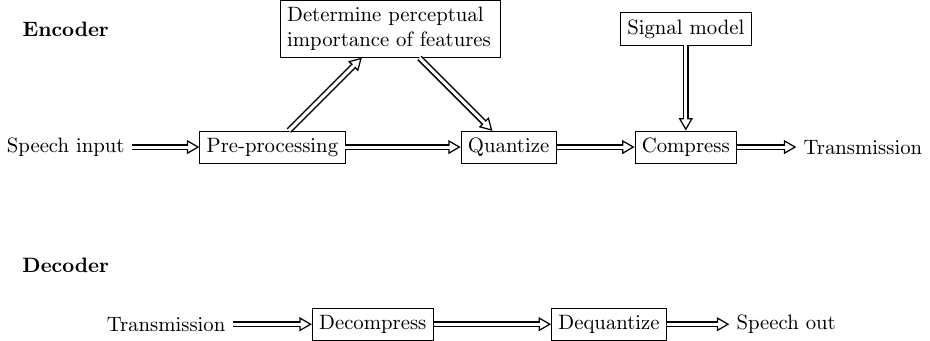
The objective of speech transmission systems is to compress the signal to as few bits as possible, while keeping the sound quality at the output as good as possible. This requires that the degradations that we introduce are chosen such that their perceptual influence is as small as possible. In other words, we would not like the listener to notice (or to notice as little as possible) that the signal has been degraded. In the illustration on the right, at the encoder on the sender side, we therefore have a model of perceptual importance, which determines how the signal is quantized. The quantized signal is then compressed to as few bits as possible. For such compression, we use statistical information about speech signals.
The decoder at the receiving side, reverses the steps by decompression and dequantization.
Pre-processing operations would typically include noise attenuation and voice activity detection (see below).
Information extraction
We can extract many types of information from a speech signal, like text content and speaker identity. Many such forms of information can be categorized by labels, that is, we give a label to a particular speech signal. That label can be, for example, the word which was pronounced or the speaker identity. Alternatively, such extracted information can be continuous-valued, such as the age of the speaker or mood (how glad/angry are you?), but we can treat both types of information as labels.
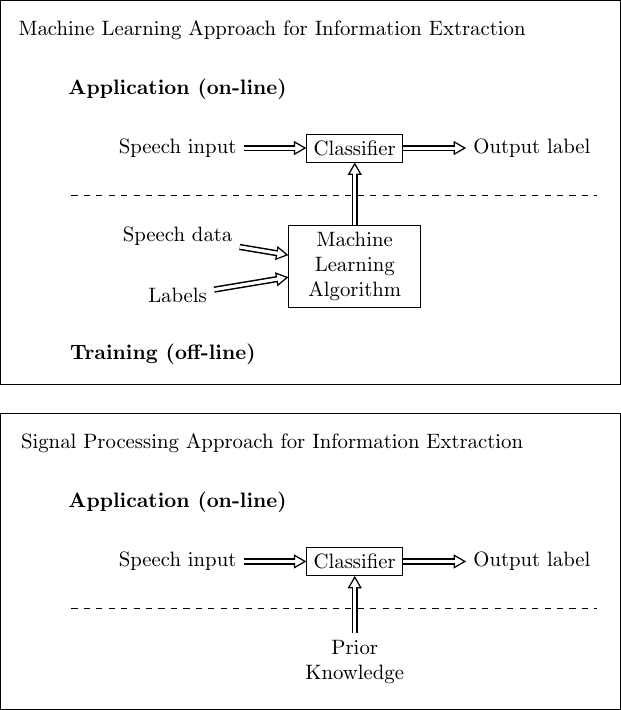
Such information extraction methods are today predominantly machine learning methods. A typical configuration is illustrated on the right, where the systems is trained off-line with a database of speech and corresponding labels. Once the system has been trained, it “knows” how to derive labels from speech input, such that in the actual use (application) of the model, it can classify input speech to give an estimate of the label.
In many cases, information extraction can also be implemented as a signal processing task, where we use prior knowledge of the signal to devise our algorithm. For example, for estimating the fundamental frequency (pitch) of a speech signal, we can readily use our knowledge to devise efficient algorithms. Such algorithms are usually an order of magnitude simpler than machine learning methods, but if the task is complicated, then the accuracy of the output is reduced correspondingly.
Speech synthesis
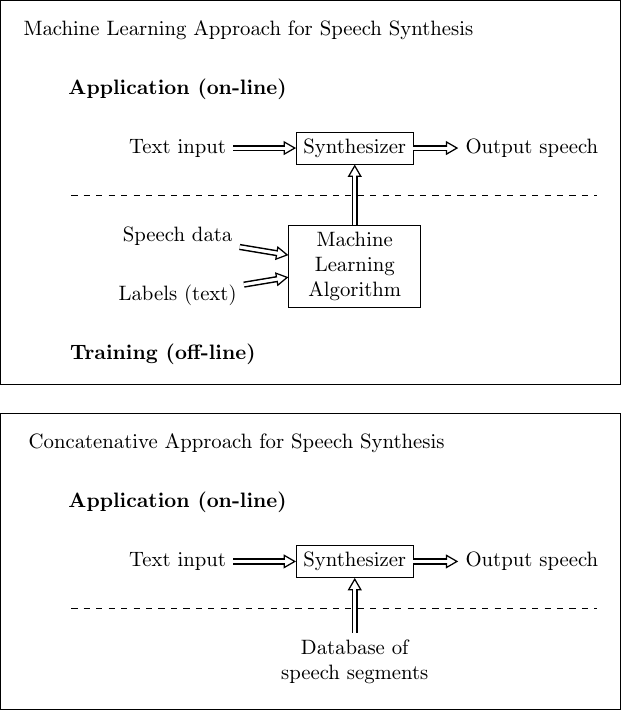
When we want to make a computer speak, we need a speech synthesiser, which takes text as input and outputs speech. It is thus the reverse of the information extraction -task, in that the roles of speech and labels (text) have been switched (see figure on the right). As in information extraction, here we can also use simpler methods when applicable. The classical method is concatenative synthesis, where segments of speech, from a database, are fused together to form continuous sentences. Such methods are common for example in public announcement systems (e.g. train stations), where the range of possible announcements is known in advance.
User-interfaces
User interfaces can employ speech to accept speech commands and/or respond with speech. For example,
A car navigator can give instructions with speech, while accepting commands only through the touch (tactile) interface.
An automatic door can accept speech commands (“Door, open”) but give no audible feedback.
Fully speech operated interfaces, like smart speakers, both accept speech commands and give spoken feedback.
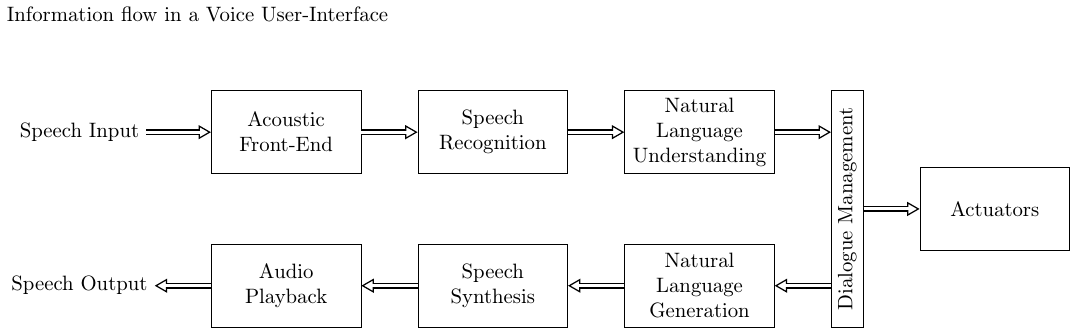
The unidirectional systems with only speech recognition or only speech generation are thus subsets of “full” speech operated systems. The stack of modules of such a complete speech operated system is illustrated on the right. Here the acoustic front-end (can) contain such pre-processing methods described in the following section. Natural language understanding assigns meaning to a sequence of words, dialogue management maps that to a specific action, implemented by the actuator(s), and natural language generation refers to the generation of an answer, in text form.
Processing and preprocessing
Irrespective of the application, most systems that operate with speech signals suffer from similar types of problems:
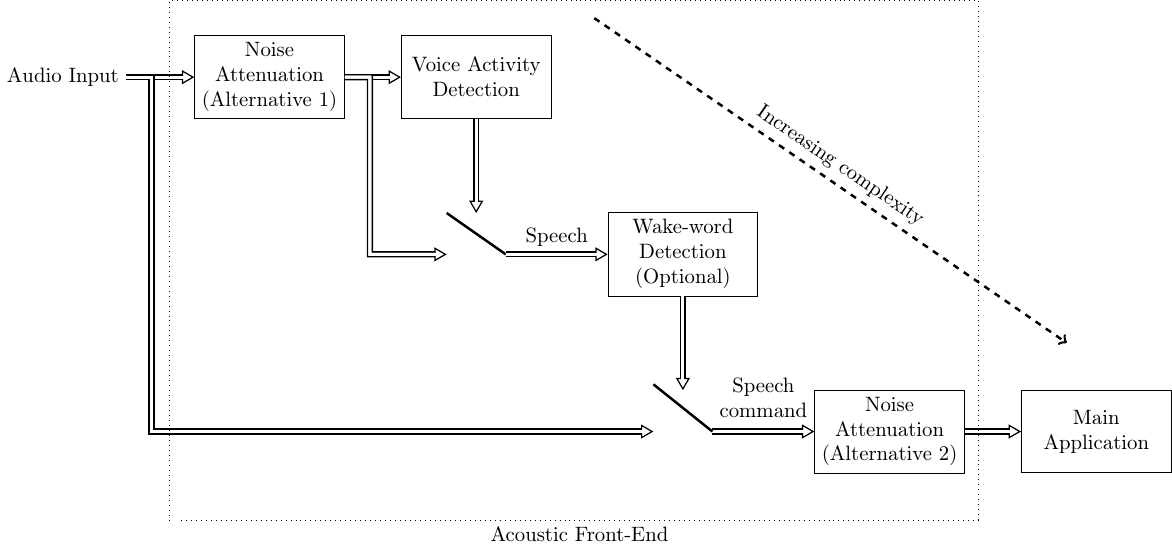
The main application is expensive to run, so it would be useful to have a pre-processing unit which detects when it makes sense to trigger the main application. For example, when nobody is speaking, it does not make sense to run a speech recognizer.
Devices are used in real-world environments, where background noises and room echo are common. It would therefore be useful to clean up the signal prior to feeding to the main application.
Such functions typically constitute the acoustic front-end.
Voice activity detection
When there is no speech, most speech processing operations are meaningless. Voice activity detection refers to the classification of signal segments according to whether they contain speech or not.
Keyword spotting or Wake-word detection
In most practical situations where voice operated devices are present, we want to be able to talk with people and not only the device. In other words, we need to know when the user is speaking to the device and when not. The device then doesn’t have to try make sense of speech which is directed to someone else. Wake-word detection (or spotting) refers to a process which is just waiting for a specific word, which triggers the main application. For example, smart speakers of the Amazon Alexa brand wait for the user to say the wake-word “Alexa”, and only after identifying that word, it starts the main process.
Speech enhancement
We can try to remove the detrimental effect of background noises and room echoes with speech enhancement methods. Imagine for example how difficult it is to understand someone on the phone, when the remote speaker is standing on a busy street loud cars driving by. With noise attenuation we can reduce such noises to make speech more pleasant to listen at the receiving end. Also any other processing becomes simpler if the speech signal is more clean. Thus a voice user-interface can feature noise attenuation as pre-processing. Note however that also other processes such as voice activity detection and wake-word detection become easier on the clean signal (see alternative 1 in the figure on the right). However, since noise attenuation can be a computationally expensive process, it might be better to apply when we already know that the signal is a speech command (see alternative 2 in the figure on the right), though this will reduce the accuracy of voice activity and wake-word detection.
Other signal processing
Speech signals can be processed further by an array of different algorithms as desired. For example:
Signals can be modified for artistic purposes with tools such as auto-tune, where the pitch of a singing voice is modified to match a desired pitch.
Speech signals can be translated to some other language.
The identity of a speaker can be hidden (or spoofed) for security purposes like witness-protection, or for illegal activities like fraud.