In multi-channel speech enhancement, a regularly appearing task is to estimate the time-delay between channels or equivalently, the angle at which a wavefront arrives to an array of microphones. By knowing the time-delay or angle of arrival, we can use beamforming to isolate sounds from that particular direction. A frequently used method for time-delay estimation is the generalized cross-correlation (GCC) method and especially its PHAT-weighted variant known as GCC-PHAT Knapp & Carter, 1976Azaria & Hertz, 1984Kwon et al., 2010.
Generalized cross-correlation
The cross-spectrum of two spectra and is
where and are the frequency and time indices. The spectra are of form , where is the time-offset and is the length of the analysis window. We thus have
If the time-difference between channels is , then
It can be weighted with a variety of approaches such as
to obtain the generalized cross-spectrum. The generalized cross-correlation is the inverse Fourier transform of the generalized cross-spectrum
where is the Dirac-delta function. In other words, the generalized cross-covariance has a single peak whose position indicates the time-delay between the two channels.
Source
import numpy as np
import matplotlib.pyplot as plt
from scipy.io import wavfile
import scipy
import IPython.display as ipd
from helper_functions import stft

# read from storage
filename = 'sounds/temp.wav'
fs, data = wavfile.read(filename)

delay_samples = 20
delay_zeros = np.zeros(delay_samples)

data1 = np.concatenate((data,delay_zeros))
data2 = np.concatenate((delay_zeros,data))

noise_gain_dB = -10
noise_gain = np.std(data)*10**(noise_gain_dB/20)

observation1 = data1 + noise_gain*np.random.randn(len(data1))
observation2 = data2 + noise_gain*np.random.randn(len(data1))
X1 = stft(observation1,fs)
X2 = stft(observation2,fs)
crossspectrum = np.mean(np.conj(X1)*X2,axis=0)
crosscorrelation = scipy.fft.irfft(crossspectrum/np.abs(crossspectrum))Source
plt.figure(figsize=[8,6])
plt.subplot(211)
ix = np.argmax(observation1)
plt.plot(range(ix-100,ix+100),observation1[(ix-100):(ix+100)],label='Channel 1')
plt.plot(range(ix-100,ix+100),observation2[(ix-100):(ix+100)],label='Channel 2')
plt.xlabel('Time (samples)')
plt.ylabel('Amplitude')
plt.legend()
plt.title('Input signals')

plt.subplot(212)
plt.plot(crosscorrelation[0:100],label='Cross-correlation')
plt.plot([delay_samples,delay_samples],[-.1,.6],'r--',label='True delay location')
plt.legend()
plt.xlabel('Sample $k$')
plt.ylabel("Generalized cross-correlation $r_k'$")

plt.tight_layout()
plt.show()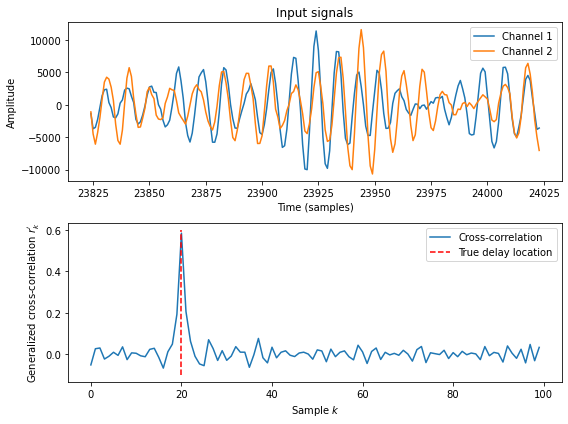
- Knapp, C., & Carter, G. (1976). The generalized correlation method for estimation of time delay. IEEE Transactions on Acoustics, Speech, and Signal Processing, 24(4), 320–327. 10.1109/TASSP.1976.1162830
- Azaria, M., & Hertz, D. (1984). Time delay estimation by generalized cross correlation methods. IEEE Transactions on Acoustics, Speech, and Signal Processing, 32(2), 280–285. 10.1109/TASSP.1984.1164314
- Kwon, B., Park, Y., & Park, Y. (2010). Analysis of the GCC-PHAT technique for multiple sources. ICCAS 2010, 2070–2073. 10.1109/ICCAS.2010.5670137